Burst Fade Mullet
| |

35 best Burst Fade Mullet hairstyles for men in 2026: How It Actually Work For You

The burst fade mullet is one of those haircuts that looks impossibly cool when it’s fresh off the barber’s chair, and like a disaster three weeks later if you don’t know what you’re doing. I’ve been barbering for over a decade, and this cut has become one of the most requested styles in my shop over the past couple of years. Guys see it on social media and want it immediately. The problem? Most of them have zero idea how to style it at home once they leave.

That’s what this guide is for. I’m going to walk you through exactly how to style a burst fade mullet, how to maintain it, what products actually work, and what most guys get completely wrong. Whether your hair is stick-straight, curly, thick, or thin. There’s a version of this cut that can work for you. Let’s get into it.

What Is a Burst Fade Mullet , Exactly?

 Burst Fade Mullet

A burst fade mullet combines two distinct techniques: the burst fade and the classic mullet structure. The burst fade radiates outward from behind the ear in a semi-circular arc, almost like a sunburst pattern, tapering the hair short around the ear and gradually blending into the longer hair above and behind it. That’s what separates it from a standard taper fade or a mid fade mullet, which follow more linear blending paths.

The mullet component means the top and sides stay relatively longer while the back has length. Business up front, party in the back, as the old saying goes. When you marry these two elements, you get a cut with dramatic contrast, a clean arc of skin fade around the ear, and a flowing or textured back section that gives the whole look a lot of personality.

The Difference Between a Social Media Mullet and a Real-Life Wearable Mullet

social media mullet and real life mullet

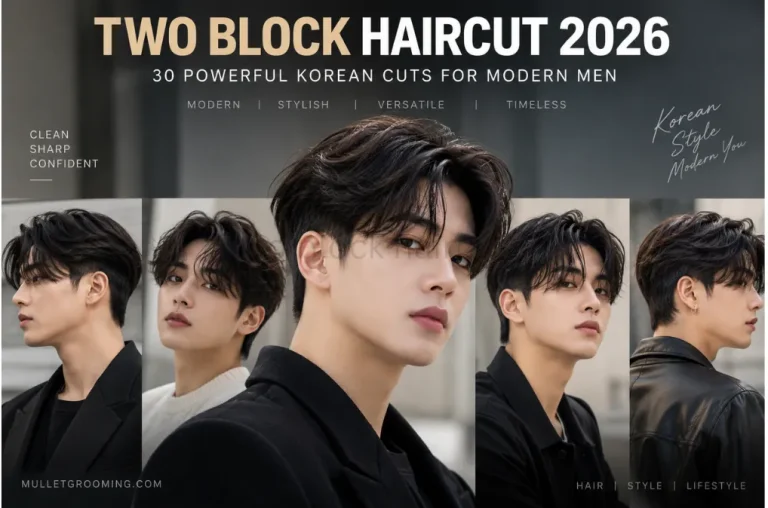
Social media photos can be great inspiration, but remember they’re usually taken right after a fresh haircut, styled with professional products, and photographed under perfect lighting. Instead of expecting an exact copy, use those images as a reference and let your barber adapt the Korean mullet to your hair type, face shape, and lifestyle. The best haircut is one that looks great and is easy to style every day.

How Face Shape Affects Your Burst Fade Mullet

Face Shape Affects Your Burst Fade Mullet

Oval Face Shapes

Lucky you. Oval faces are the most versatile. You can pull off almost any variation of the burst fade mullet, including more dramatic versions with heavier contrast and longer backs. If you’re oval-faced, lean into the style you love most.

Square Face Shapes

Square faces have strong jawlines and angular features. The burst fade works really well here because the rounded arc of the fade actually softens the corners slightly. I’d recommend keeping the top section with some texture rather than slicking it flat, as adding height and volume up top balances the jaw width.

Round Face Shapes

Round faces need vertical length to avoid looking wider. Go for a longer back section and consider a bit of height in the front or crown. Avoid cuts where the sides and the back are the same length, as that adds visual width without counterbalancing it. The burst fade’s arc is naturally flattering for round faces because it creates a slimming effect around the ear.

Oblong or Long Face Shapes

Longer faces can benefit from a burst fade mullet that doesn’t emphasize too much vertical height. Keep the top relatively flat and focus on the texture and shape of the back instead. A wider, fuller back section can add some perceived width.

Diamond Face Shapes

Diamond faces (narrow forehead, wide cheekbones, narrow chin) pair well with a burst fade mullet that has some fullness at the top and a tapered back. Avoid excessive volume at the cheek level. The burst fade’s clean arc helps here by keeping the sides tight.

What to Tell Your Barber Before You Even Sit Down

Barber Before You Even Sit Down burst fade mullet

Client communication is everything. I can’t tell you how many times someone has sat in my chair, said ” I want a burst fade mullet ” and we’ve ended up in completely different places mentally. Here’s how to walk in prepared:

Bring a reference photo. It takes the guesswork out of the conversation. Even if your hair doesn’t match the photo exactly, your barber can translate the key elements (the fade height, the back length, the texture) to suit your hair type.

Know your neckline preference. Burst fade mullets can have a squared neckline, a tapered neckline, or a rounded one. This matters more than most guys realize. A squared neckline looks sharp and defined. A tapered or rounded neckline looks more natural and grows out cleaner.

Tell them about your maintenance schedule. If you’re coming in every three weeks, your barber can cut differently than if you’re a six-week-between-cuts person. A burst fade with very tight skin around the ear looks incredible on day one and terrible by week four if it’s not refreshed.

Be honest about your styling routine. If you spend two minutes in the bathroom every morning, say that. A low-maintenance cut exists, but your barber has to know to build it that way.

How to Style a Burst Fade Mullet : Step-by-Step

How to Style a Burst Fade Mullet

Step 1: Start With Damp, Towel-Dried Hair

Don’t style bone dry and don’t style soaking wet. Towel-dry your hair after the shower until it’s about 70% dry. This is your optimal window for product application and shaping.

Step 2: Apply Your Base Product

Work a pea-sized amount of hair cream or a light matte clay into your palms and distribute it through the back section and top of your hair. This gives you something to work with and sets the foundation before heat styling.
For straight or fine hair, go light here. For thick or curly hair, you can use a bit more.

Step 3: Rough Dry With a Blow Dryer

This step is where most guys skip out, and it’s a mistake. Use a blow dryer on medium heat to rough dry the hair while shaping it with your fingers. Push the back section downward and slightly outward. For the top, push it forward or to the side depending on your preferred direction.
The rough dry sets the shape. Everything after this is refinement.

Step 4: Define the Back Section

Once the hair is about 90% dry, use your fingers or a wide-tooth comb to define the back. If you have straight hair, you can smooth it down. If you have textured or curly hair, use your fingers to encourage the natural pattern.
For a more lived-in look, scrunch the back section lightly. For a sleeker, more deliberate style, use a light comb-through.

Step 5: Finish With Your Styling Product

This is where product choice matters. A few options:

  • Matte clay: best for a natural, textured finish with medium hold
  • Sea salt spray: works exceptionally well on wavy and curly hair; gives a beachy, effortless texture to the back
  • Pomade: if you want more shine and a cleaner look on the top section
  • Texture powder: excellent for fine hair that needs volume and grip without weight

Apply your finish product to the back and the top, then shape with your fingers. Don’t over-work it. The burst fade mullet looks best with movement, not rigidity.

Step 6: Let It Set

Give it two to three minutes before you touch it again. The product needs to set. Running your hands through it constantly while it’s fresh will break up the hold and leave it looking messy rather than intentionally textured.

Product Breakdown: What Works and What Doesn’t

Product Breakdown burst fade mullet

Sea salt spray is underrated for this cut. Most guys think of it as a beach product, but it’s genuinely one of the best finishing tools for the back section of a burst fade mullet, especially on wavy or curly hair. It enhances natural texture without making hair feel heavy or crunchy.

Matte clay is the most versatile option. It gives workable hold, looks natural, and doesn’t require a specific hair texture to perform well. Start with a small amount. You can always add more.

Pomade is good if you want a defined, slightly polished finish on the top section. High-shine pomade can look great but also makes the cut look more vintage than modern. Water-based pomade is easier to wash out.

Texture powder is a secret weapon for fine or thin hair. Dust a little at the roots of the top section and work it in. It creates grip, volume, and hold without adding any visible product buildup. It’s also great for refreshing the style on day two.

What doesn’t work: heavy waxes and stiff-hold hairsprays tend to kill the natural movement that makes the burst fade mullet look good. Avoid anything that makes the back section stiff or plastic-looking.

Styling for Your Hair Type

Straight Hair

 Burst Fade Mullet

Straight hair gives you clean, defined results. The burst fade blends look especially crisp. The challenge is volume and movement in the back. Use a blow dryer with a round brush to add some body, and finish with matte clay or a light pomade. Without some heat styling, straight hair can lie flat and make the back look limp.

Curly Hair

Curly Hair mullet

Curly hair is honestly great for this cut. The natural curl pattern adds dimension to the back section without much effort. The key is moisture. Use a hydrating cream as your base layer to keep the curls defined, not frizzy. Sea salt spray on top of that enhances the texture further. Don’t use a brush on curly hair after it’s dry; use your fingers only.

Thick Hair

burst fade mullet thick haircut

Thick hair holds shape well but can get bulky if the cut isn’t right. Make sure your barber texturizes the back section to remove some bulk. This is called point cutting or slide cutting, and it keeps the shape clean rather than boxy. Style-wise, matte clay is your best friend.

Thin or Fine Hair

Thin or Fine Hair burst mullet

Thin hair requires more attention to volume. Texture powder is your go-to product. A blow dryer is non-negotiable for fine hair, as air-drying leaves it looking flat. Style the top section with some height to balance the back length, and keep the back length moderate. Too much length in the back with fine hair looks sparse.

Humidity and Weather: The Enemies Nobody Talks About

humidity effect on burst mullet haircut
  • Apply product to damp hair, not dry hair. Product applied to wet or damp hair creates a barrier that’s more humidity-resistant than product applied to dry hair.
  • Use a light hold spray as a final layer on humid days. It doesn’t need to be stiff, just a quick mist to seal the style.
  • Don’t fight your hair in extreme humidity. On particularly sticky summer days, lean into your natural texture rather than trying to force a polished look. A burst fade mullet actually looks great with controlled natural texture.
  • Microfiber towels reduce frizz. Swap your regular bath towel for a microfiber one. The terrycloth texture of regular towels roughens the hair cuticle and amplifies frizz.

How Often Should You Be Getting This Cut Cleaned Up?

The burst fade mullet is not a low-maintenance cut in terms of barbershop frequency, at least not if you want it to keep looking intentional.

Here’s a realistic schedule:

Every 2–3 weeks: If you have a tight skin fade around the ear and a very precise neckline, you’ll want to come in this often. The fade grows out quickly, and once it’s fuzzy, the whole shape of the cut changes.

Every 4 weeks: If your fade is a bit higher and not as tight to the skin, you can stretch it to four weeks. The burst arc will soften but still be visible.

Every 5–6 weeks: At this point, the fade will be noticeably grown out. Some guys like this. It shifts toward more of a textured low taper mullet look. If you’re comfortable with that transition, it works. If you want the burst to stay sharp, come in sooner.

Also: ask your barber to do a neckline cleanup at your appointments even if you’re not getting the full cut. A clean neckline makes a significant difference in how polished the whole thing looks.

Common Mistakes Guys Make With This Cut

After years of seeing guys walk back in after their first burst fade mullet, here are the mistakes I see most often:

1. Waiting too long to come back in. The burst fade specifically needs regular maintenance. A regular taper or a mid fade forgives longer gaps between cuts better than a burst fade does.

2. Using too much product. More product is not better. Too much clay or pomade makes the back section look greasy and heavy. Start with less than you think you need.

3. Skipping the blow dryer. I get it. It takes extra time. But for most hair types, air-drying a mullet results in a flat, shapeless back section. Even five minutes of rough drying makes a notable difference.

4. Not telling the barber their lifestyle. I’ve given guys very high-maintenance cuts when they needed something they could style in two minutes. The cut has to match your actual routine, not your aspirational one.

5. Choosing the wrong length for the back. Guys with fine hair often want the longest possible back section, but a shorter, choppier back actually looks fuller and more intentional on fine hair.

6. Not asking about the neckline. A lot of guys don’t realize the neckline is a choice. Ask your barber what option suits your hair growth pattern. Some guys have a natural hairline that doesn’t play well with a squared neckline. Your barber should be pointing this out.

Conclusion

The burst fade mullet is a legitimately great haircut, one of the strongest options in the modern mullet lineup right now. But like any high-contrast, detail-dependent cut, it rewards guys who understand it.
Go in with a reference photo. Be honest with your barber about your routine. Use the right product for your hair type. Keep up with your maintenance schedule. And don’t skip the blow dryer.

FAQ

Q: What is a burst fade mullet? A burst fade mullet is a haircut that combines a burst fade (a semi-circular fade that radiates outward from behind the ear) with the longer back section of a mullet. The result is a high-contrast cut with a clean, curved fade and a flowing or textured back.

Q: How is a burst fade different from a taper fade? A taper fade follows a linear blending path from the temples down to the neckline, while a burst fade creates a rounded, semicircular arc around the ear. The burst fade adds a more dramatic visual curve to the sides of the cut.

Q: What face shapes work best with a burst fade mullet? Most face shapes can work with a burst fade mullet with the right adjustments. Oval faces are the most versatile. Round faces benefit from longer back sections that add vertical length. Square faces are complemented by the rounded arc of the burst fade. Your barber should customize the cut to your specific features.

Q: How often do I need to get a burst fade mullet maintained? For a tight skin burst fade, plan on visiting your barber every two to three weeks. For a softer fade that sits slightly higher, you can stretch to four weeks. The burst arc loses its shape as the hair grows, so regular maintenance is key.

Q: What products should I use to style a burst fade mullet? Matte clay is the most versatile all-around product. Sea salt spray works great for wavy and curly hair types, adding texture to the back section. Texture powder is ideal for fine or thin hair. Avoid heavy waxes or stiff-hold sprays that kill the natural movement of the cut.

Q: Can I get a burst fade mullet with curly hair? Yes, curly hair is actually excellent for this cut. The natural curl pattern adds dimension to the back section with minimal effort. Use a hydrating cream as a base and finish with sea salt spray. Avoid brushing curly hair after it’s dry; use your fingers to shape it instead.

Q: Why does my burst fade mullet look bad after a few weeks? The burst fade grows out faster than many other fade styles because of the tight curve around the ear. Once the fade softens, the shape of the cut changes noticeably. This is normal. It’s a sign you need a maintenance visit, not that the cut isn’t right for you.

Q: What’s the difference between a burst fade mullet and a wolf cut? A wolf cut is more closely related to the shag haircut. It features heavy layering, curtain bangs, and a lot of volume throughout. A burst fade mullet has a defined skin fade on the sides and a distinct short-to-long contrast from front to back. They share a loose, textured aesthetic, but the construction and barber technique are quite different.

Follow us for more Burst Fade Mullet inspiration:

About The Author

Hi, I’m Daniel Carter, a men’s grooming and hairstyle writer passionate about modern hair trends, barbering techniques, and practical styling advice. I create well-researched guides to help men choose haircuts that suit their hair type, face shape, and lifestyle with confidence.

Similar Posts

Leave a Reply

Your email address will not be published. Required fields are marked *